Healthcare case study · Multi-neighbourhood profiles
Population health profiles for new neighbourhoods, in days
NHS Kent and Medway ICB · Population health and commissioning
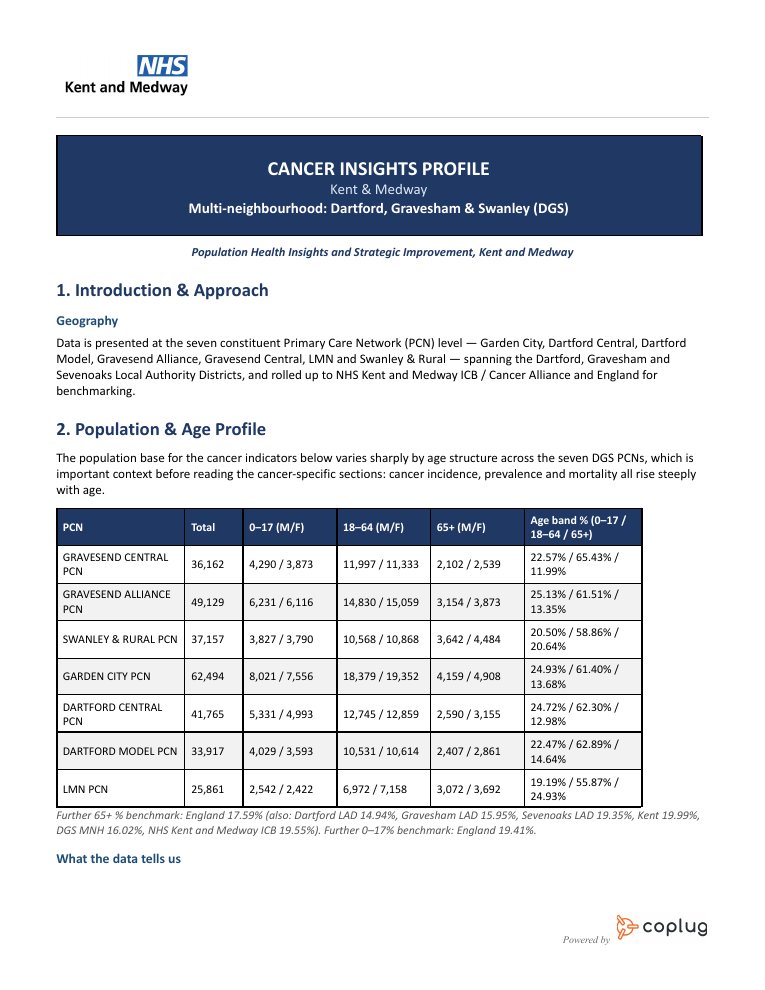
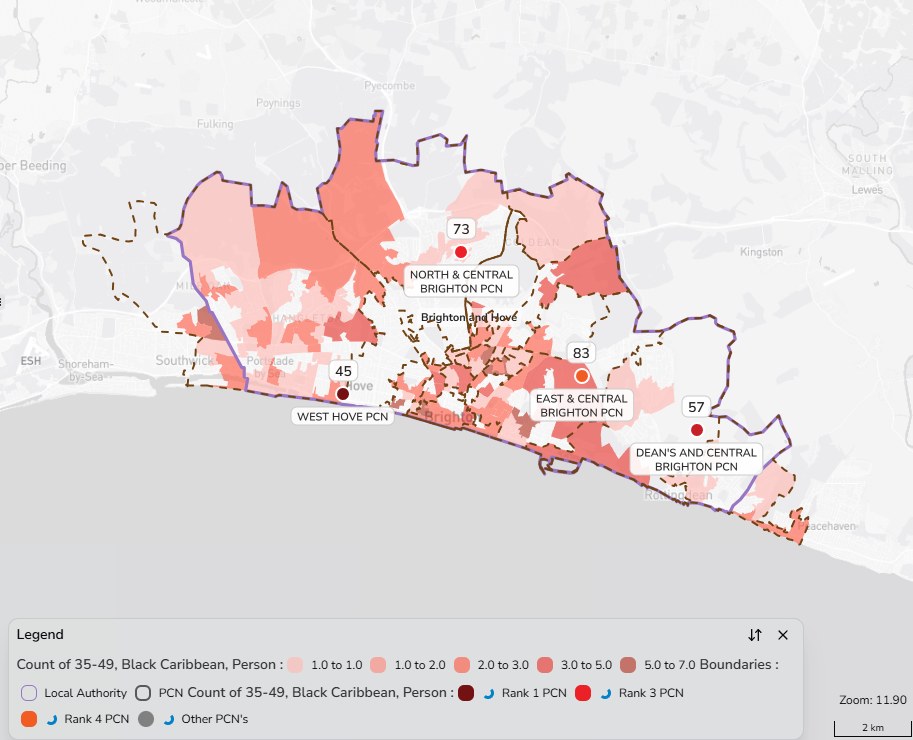
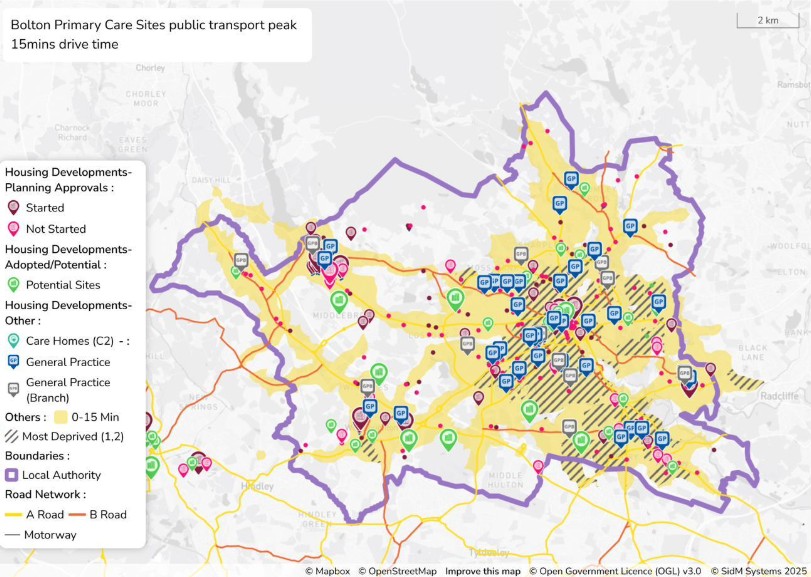
The ICB's population health and commissioning leads ran Coplug's spatial reasoning healthcare agent themselves, setting the templates and prompts, to generate profiles for every multi-neighbourhood in the ICB within a week of boundaries being confirmed.
Led by domain experts
ICB-led
agent sessions and prompts run by the ICB's own population health and commissioning leads
- 400+
- insights linked and generated for new multi-neighbourhood boundaries
- 2 days
- to generate the packs, against at least 6 weeks of evidence gathering
- 30+
- insights in each multi-neighbourhood pack
- 1 week
- from confirmed boundaries to packs
The need
Challenge. Multi-neighbourhood boundaries were defined in mid-April 2026. The ICB needed a population health profile for each one, to give stakeholders a shared understanding of local need.
Why it was hard. The boundaries were new, so no published data existed for them. More than 400 insights had to be linked and generated for custom areas, and boundaries were confirmed only a week before the packs were needed.
Driver. Neighbourhood health, population health management and commissioning planning.
What Coplug delivered
- Demographics and socioeconomic context
- Start Well: children, young people and maternity
- Living Well: adult long-term conditions and acute demand
- Age Well: palliative and end-of-life care, and care home provision
- Key findings and commissioning implications for each area
How it worked. Domain experts in the ICB led the agent sessions, wrote the prompts and set the templates and sample packs. The agent then generated a pack for every multi-neighbourhood.
Decisions it can inform
Targeting. Where to focus intensive support within each multi-neighbourhood, which cohorts and conditions to prioritise, and where commissioning resource is most needed.
Outcome. Packs generated in 2 days. Gathering the evidence would otherwise have taken the commissioning and population health team at least 6 weeks, plus several more weeks to build it for custom multi-neighbourhood areas. The result is a common evidence base shared across stakeholders, at the geography neighbourhood teams now work to.
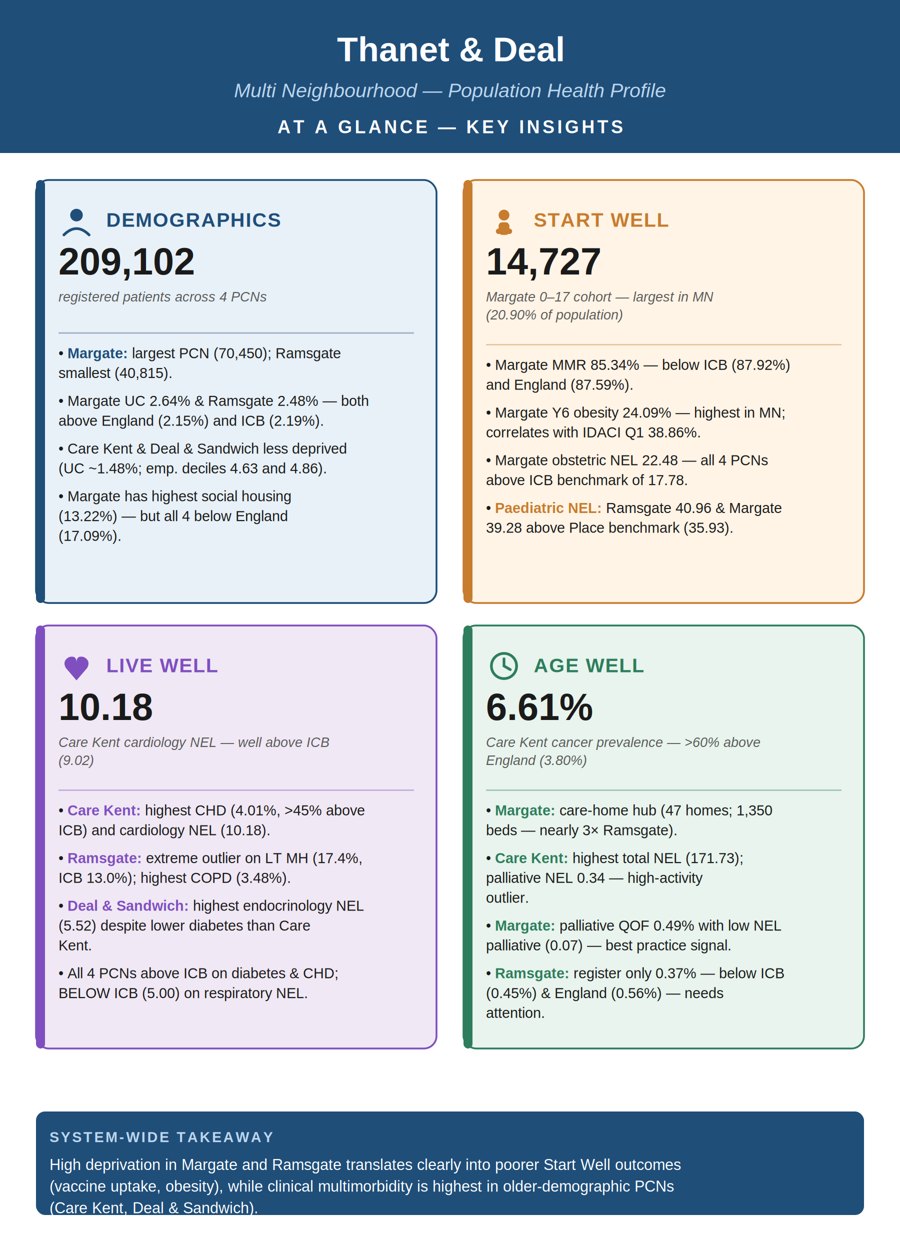
A multi-neighbourhood profile at a glance
The profile
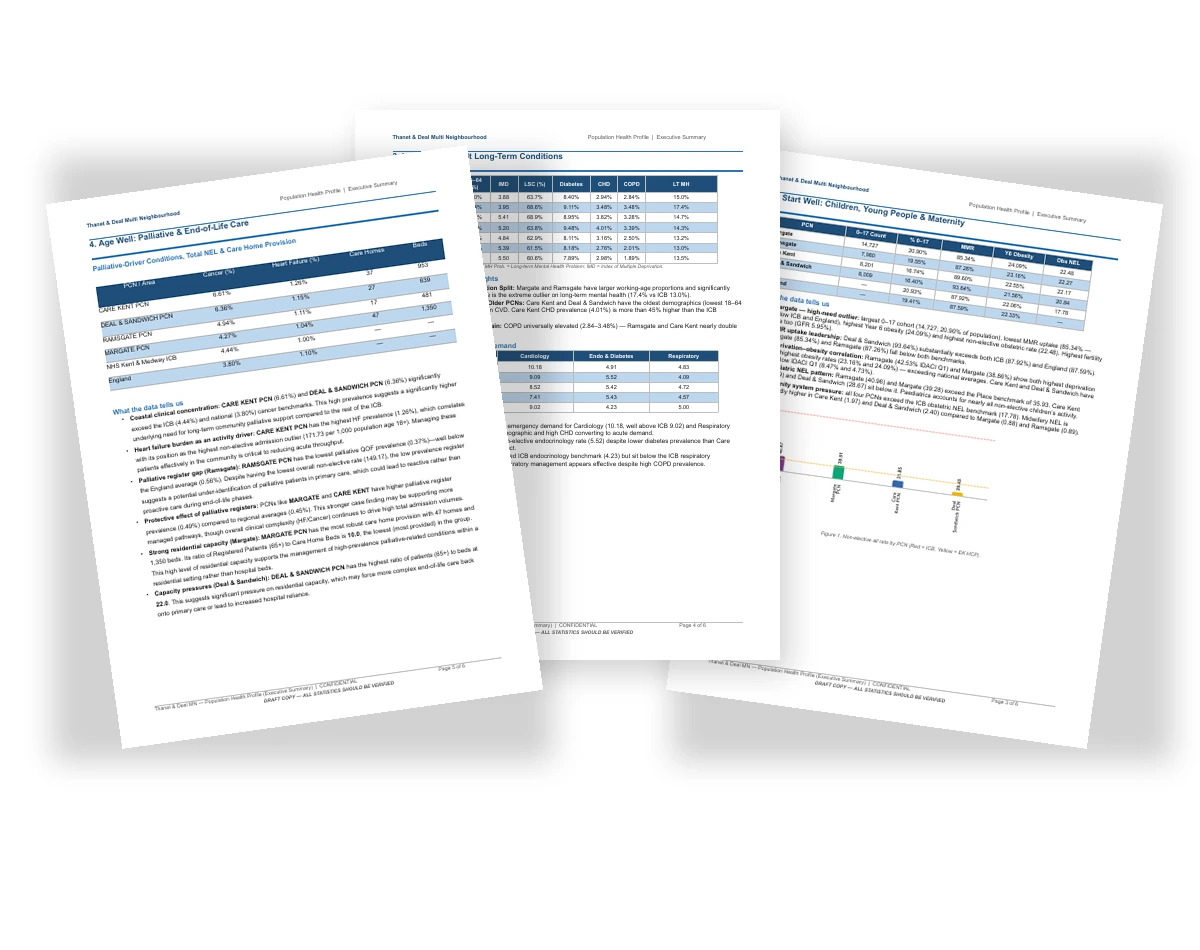
Example findings: Thanet and Deal
The outputs are not just statistics. Each profile draws out findings and recommendations for commissioners, backed by Coplug's knowledge base of national policy and evidence.
- A clear socioeconomic divide. Deprivation and benefit claims are concentrated in part of the area, while neighbouring PCNs are markedly more affluent.
- Start Well. Emergency maternity activity is high across the area, and childhood obesity and lower vaccination uptake concentrate where child deprivation is highest.
- Living Well. Respiratory disease is elevated across the area, and long-term mental health needs are highest where deprivation is greatest.
- Age Well. Older coastal PCNs carry a higher burden of cancer and heart failure, and care home capacity relative to the older population varies widely.
- Recommendation. Proportionate universalism: standard provision across all PCNs, with intensive mental health, social prescribing and long-term condition support targeted at the most deprived.
- Recommendation. A low palliative care register in one PCN suggests under-identification. Reviewing registers could support proactive rather than reactive end-of-life care.
“The Coplug agent workflow reduced our work from over 2 months to within days to develop multi neighbourhood profiles across the ICB. The ability of the agents to surface validated insights and provide meaningful recommendations is very powerful.”
Backed by industry-validated calculators and methodologies developed with NHS partners, using NHS England, ONS, OHID, QOF, SUS, UKHSA and CQC data.