There are multiple ways to use the Healthcare Agent. The short version: type your question, get your answer. No training, no manual, no answers from dubious sources, no waiting three weeks for an analyst to fit you in.
That really is how it works, and if that's all you ever do, you'll still get plenty out of it. But there is a way of working that turns interesting numbers into things you can take to a board meeting or a funding bid. Five minutes here will change what you get out of the agent.
The post is in three parts:
- 1. What users use the Healthcare Agent to look at
- 2. One way to work through a decision
- 3. What teams do with the output
1. What users use the Healthcare Agent to look at
- Pathways - A clinical condition. You choose the condition first, then look at which patients it affects, what the condition needs, and what it costs. Eg. Diabetes · CVD · COPD · SMI
- Cohorts - who to target. Picked out by who they are, such defining features such as: age, ethnicity, deprivation, disability, situation. Eg. Age · deprivation · ethnicity · care home residents · unpaid carers
- Services - where and how to run provision so that uptake improves. It could be an enhanced service, screening programme or health check. Eg. Bowel screening · NHS Health Checks · flu vaccination
- Assets - your buildings and the space inside them. Work out what population growth does to your estate: how many more patients are coming, what that means in appointments and clinical rooms, and what it costs to build, the evidence behind a capital funding bid. Eg. Practice sites · branch surgeries · clinical rooms · expansion and refurbishment
Which leads us on to...
Targeting and Recall
- Who is missing from our registers?
- Which patients should we call in first?
- Who are we not reaching, and why?
- What is the best way to get to them?
- Which cohorts have the widest gap?
- What is the unmet need?
Knowing who to reach is one thing. Being able to do it is another.
Capacity Planning
- is there enough resource for what is needed?
- How can we expand it?
- Who is doing what in the Neighbourhood?
- Who should we partner with to provide a service?
- Where should we place a service?
And if you have the people but not the room...
Capital Investment
- What is the impact of future housing growth?
- How much will our list size grow?
- What does that mean for appointments and clinical rooms?
- What would it cost to build?
- What capital funding should we apply for?
OK, but did what you do work?
Monitoring
The Healthcare Agent lets you ask questions about your population to understand it, with frequent updates, so you know what has changed.
2. One way to work through a decision
These eight steps are one route to a decision, not the only one. Most people ask a question that sits somewhere in the middle and stop when they have enough. Dive right in to one, or follow the order to tell the story:
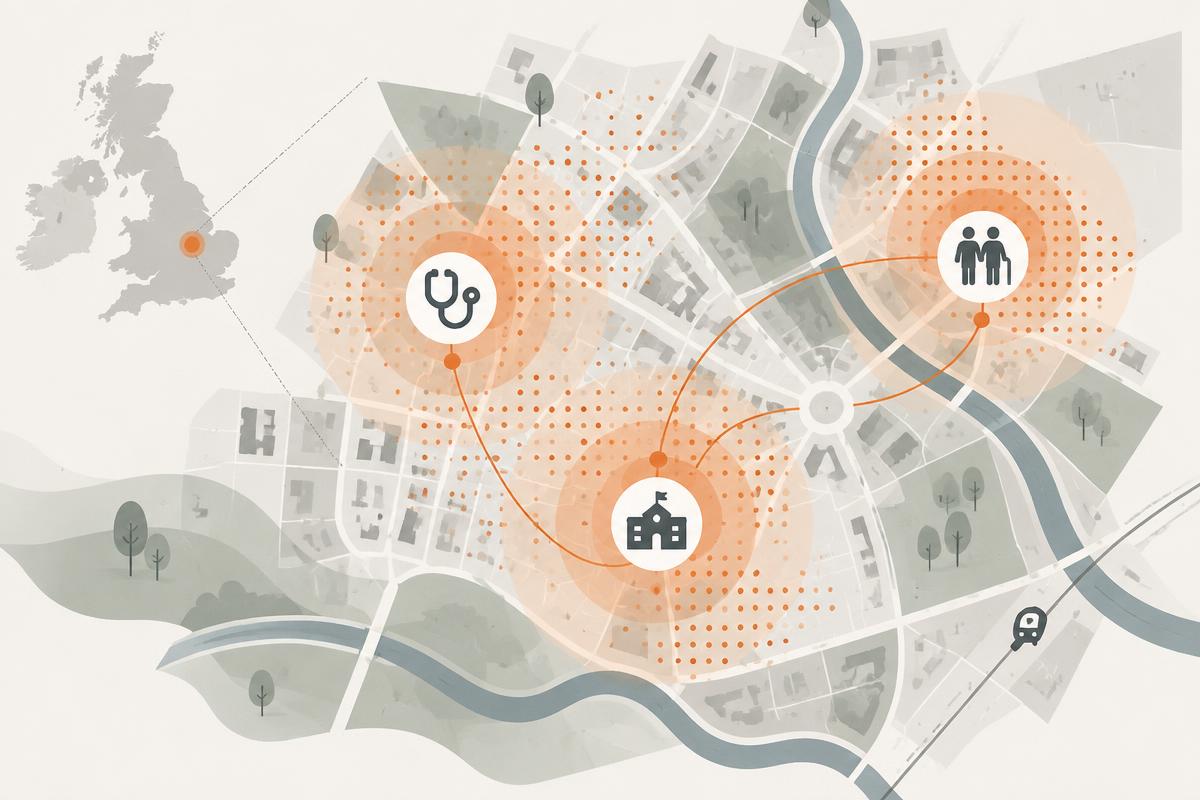
- Locate. Where they live, and which places they gather, including schools, care homes and places of worship. Everything after this is measured on that footprint.
- Quantify. How many there are and how they are doing. You have numbers, but nothing to judge them against yet.
- Benchmark. Compare against local PCNs, the ICB and similar areas. Now the number becomes a gap.
- Explain. Why that gap is there, looking at deprivation, ethnicity, language, access and workforce.
- Diagnose. The one that matters. Is the need genuinely higher here, or is the service not reaching people? Higher need means a funding bid. Poor reach means changing how you deliver.
- Act. What to actually do. This comes out of the diagnosis, not out of the data.
- Partner. Who can help deliver it, based on where the patients are.
- Forecast. How much bigger this gets, and what that means for staff and appointments.
3. What teams do with the output
- Evidence for business cases. Making the case for a new or expanded service, with the need and the size of it shown.
- Papers for board meetings. Helping the PCN decide where to focus, in language a mixed room can follow.
- Evidence for strategic planning. Setting direction over a longer horizon than the current year.
- Bidding for capital. Section 106 and estates submissions to the council or the ICB.
- Future service planning. Working out what provision will be needed, what it costs, and who delivers it.
- Monitoring operations. Tracking practice performance, achievement and satisfaction quarter to quarter.
- Optimising patient recall and interventions. Deciding who to call in, in what order, and how to actually reach them.
The point is not the data. It is the decision that follows it.