Healthcare case study · Maternity estate
Matching maternity capacity to where need is
NHS Kent and Medway ICB · For the CFO and wider stakeholders
Coplug's spatial reasoning healthcare agent brought together hospital activity, travel-time access and local need to show how maternity services are used across nine sites and four trusts, and set out estate options for the ICB to consider.
Beyond published data
19 / 30
insights built from SUS activity, custom catchments and site-level flows not publicly available
- 30+
- insights across activity, access, need and growth
- 77k+
- maternity admissions from SUS, by site and specialty
- 9 / 4
- hospital sites and trusts analysed
- 55
- PCN-to-trust activity flows mapped
The need
Challenge. Understand whether maternity capacity sits where the need is, and which estate options could improve access and use of existing sites.
Why it was hard. Activity, access and need sit in separate datasets at different geographies. Published statistics report activity by trust, not by site, and do not show which communities flow to which units or who can reach them within 30 minutes.
Driver. ICB estate strategy, financial planning and equitable access to maternity care.
What Coplug delivered
- How PCNs link to trusts: activity flows from practices and PCNs to each trust
- Where the activity is: SUS admissions by site, across midwifery, obstetrics and gynaecology
- Demand outlook: women aged 20 to 44 in each site's catchment, projected to 2043
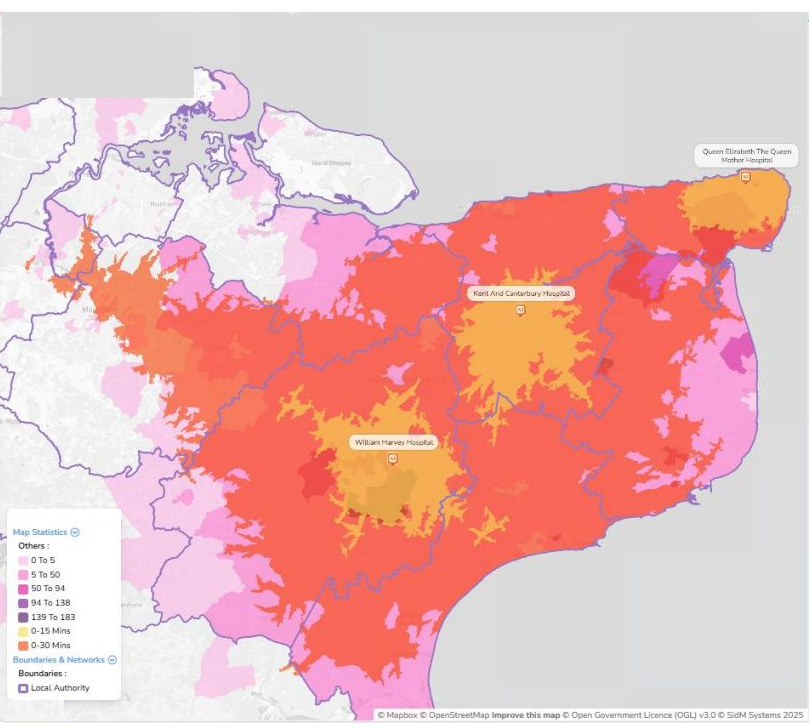
- Coverage: who can reach a consultant-led unit within 30 minutes
- Need: admission rates, deprivation and infant cohorts by PCN
- Synthesis: need against location, with site access maps
- Estate options for the ICB to consider
Decisions it can inform
Estate options. Which sites to protect, where activity could be rebalanced between sites, and where existing low-activity estate could host community capacity rather than be disposed of.
Outcome. A single, site-level view of activity, access and need. It shows that need is concentrated on the coast and Thames-side while capacity is weighted west, and identifies the communities furthest from a consultant-led unit.
Access and admissions: East Kent
The report
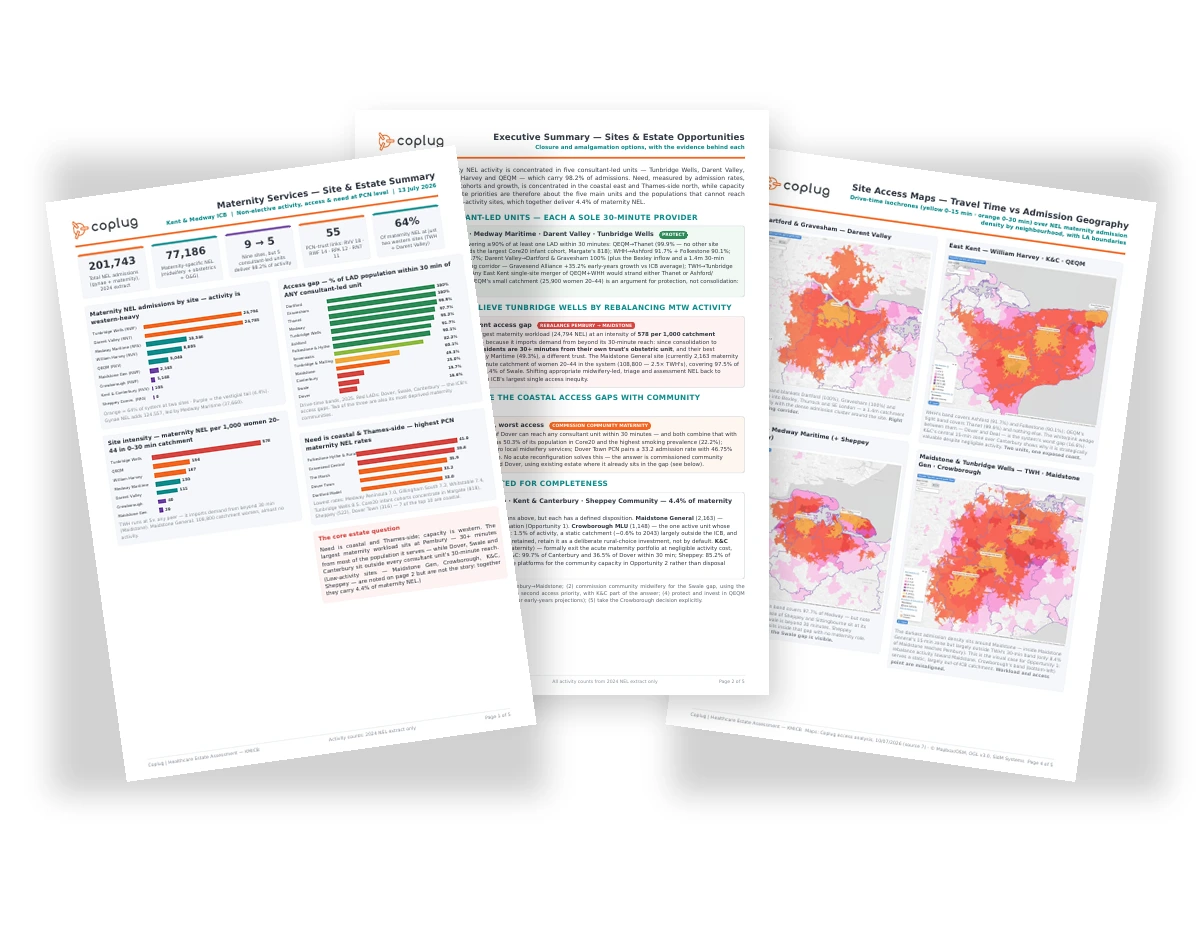
Key findings and possibilities
The outputs are not just statistics. Each section draws out findings and options for the ICB, backed by Coplug's knowledge base of national policy and evidence.
- Activity is concentrated. Five consultant-led units carry 98% of maternity activity, and almost two-thirds sits at just two sites in the west of the county.
- Need sits elsewhere. The highest admission rates, deprivation and infant cohorts are on the coast and along the Thames, away from where most capacity sits.
- Access gaps. In three districts, fewer than one in four residents can reach a consultant-led unit within 30 minutes by car.
- Workload and catchment misaligned. The busiest unit runs at around five times the intensity of its peers, drawing demand from beyond its own 30-minute reach.
- Possibility: rebalance. Shifting suitable midwifery-led, triage and assessment activity to an underused site within the same trust could relieve pressure and close the largest access gap.
- Possibility: reuse existing estate. Low-activity sites that sit inside the access gaps could host community maternity capacity, using estate the system already holds.
Backed by industry-validated calculators and methodologies developed with NHS partners, using SUS activity, NHS England, ONS and deprivation data.